I said at the end of the last post that I did not want postcolonial, indigenous, and contextual mission to resolve into one clean framework. I still do not. But a practitioner cannot live forever in three separate rooms, especially not in a Britain where those three rivers are already colliding, in the reverse mission movement, in the contested word indigenous, in the gap between Fresh Expressions and the diaspora congregations doing parallel work without parallel platforms. Somewhere young people still turn up at the skate park, and I still have to decide, how to stand among them.
So this post is not a synthesis in the philosophical sense, three arguments merged into a fourth. It is older than that, and it is mine, in the sense that anything borrowed and lived in for four decades becomes yours. I want to reach back into work I was already doing before I had these three words lined up so neatly, back to Here Be Dragons, and to two ideas that have already done a lot of work earlier in this series: sobornost, which I first brought in when I was trying to name what reciprocity actually looked like around a banqueting table, and an unfolding habitus, which I borrowed from Bourdieu a few posts ago to explain why you cannot study your way into belonging.
Postcolonial mission will not let me forget history. It stands behind me while I plan and asks who taught me to plan this way, whose interests that method once served, what got erased so this shape of church could feel natural to me. It is currently teaching me something sharper still, Kwiyani’s distinction between hospitality and mutuality, and it will not let me settle for having welcomed someone when what was actually being asked of me was to hand over some of the room’s actual authority (Kwiyani, 2025). Its gift to me and to contextual mission is a permanent, low grade suspicion of my own instincts, and a standing question about whose meeting it still is once the guest list has diversified.
Indigenous mission will not let me forget that some people’s dispossession is the ground I am standing on, even when I did not personally cause it, and it will not let me borrow its name for my own smaller, newer, whiter thing, however much that name might flatter the work. Its gift to me and to contextual practice is a permanent reminder to run deeper so contextual means more that something stylistic.
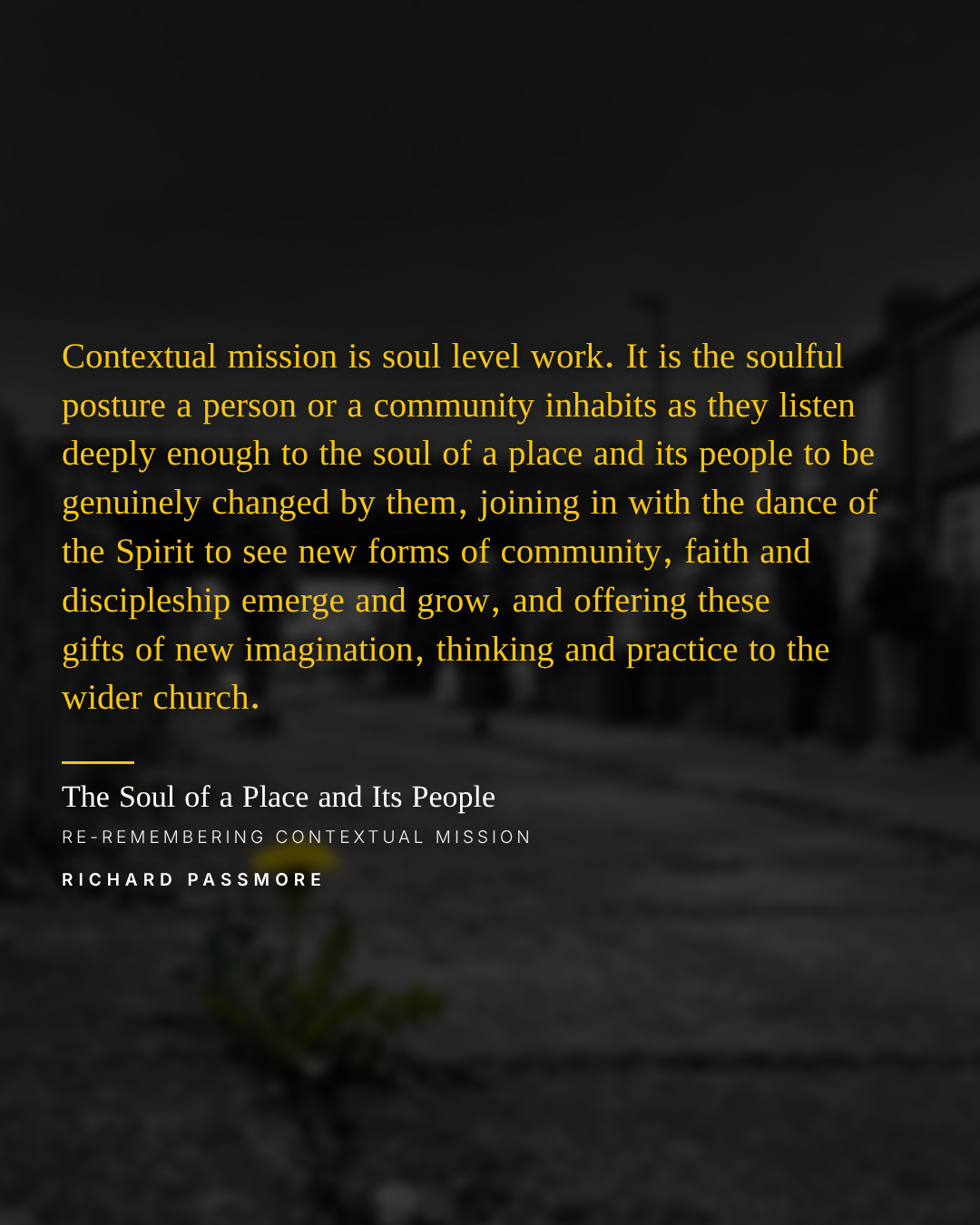
Contextual mission will not let me forget the actual room I am in, the actual young people, the actual skate ramp, the actual slow years it took before Church of Flow stopped being mine and became theirs, the same slow years I described as the whole engine of a genuinely reciprocal relationship. Its gift is incarnation. Its danger, and I keep saying this because it keeps being true, is that incarnation can quietly become market segmentation, the same logic underneath the Homogeneous Unit Principle, a gospel sold back to a niche audience as though relevance were the same thing as faithfulness.
Long before I had postcolonial, indigenous, and contextual lined up as three separate conversations, I was already reaching for a fourth word to hold what Church of Flow was teaching me, and the word was sobornost. It is Russian Orthodox in origin, sometimes translated simply as a spiritual community of many jointly living people. I have written before that I think sobornost matters precisely because it is rooted in practice, action, dialogue, and community rather than in doctrine handed down or method imported. Rowan Williams, drawing on the same Khomiakovian tradition, describes sobornost as the gathering of free persons into one organic body, not merely the sum of its parts but an active, living wholeness, a quality of togetherness rather than a headcount or an institutional shape (Williams, 2021).
Notice what sobornost quietly refuses to do. It does not ask who is indigenous and who is not. It does not ask whose framework gets to be the umbrella and whose gets absorbed into it. It asks only whether the people gathered are actually free, actually seen, actually jointly living rather than merely gathered in the same place. A postcolonial critique, an indigenous voice, and a contextual practitioner can sit inside a sobornal community without any of them having to surrender their distinct ground to the others. That is not synthesis in the sense of blending. It is synthesis in the older sense, a household large enough to hold real difference without flattening it, the same household I was describing when I wrote about the narrowness of a single congregation being legitimate only if it stayed sobornostically bound to the wider Church.
The second half of what I want to bring back is Bourdieu’s habitus, and specifically the way I have argued, in Here Be Dragons and again earlier in this series, that it needs to be unfolding rather than fixed. Habitus, in Bourdieu’s own terms, is culture’s way of behaving, the norms we are socialised into so deeply we mistake them for nature (Bourdieu, 1977). But Bourdieu also suggested that habitus is not simply imposed on us from outside. Through our participation, we contribute to its ongoing reshaping. It is a two way, dialogical, iterative process, not a mould we get poured into once, which is exactly what I meant when I said earlier in this series that a shared habitus is not something you can study your way into.
This is where I think the answer to my own question in the last post actually lives. The reason I cannot call my contextual work indigenous is that indigenous names a habitus, a whole cosmology, held and reshaped by a specific people over generations of that same iterative, embodied participation. Even though I have dipped a toe in, I have not done that work, in that place, with those ancestors. But the reason contextual mission is not therefore powerless or merely borrowed is that an unfolding habitus is available to any community willing to keep participating honestly in its own reshaping, in line, as I wrote in Here Be Dragons, with the character of God revealed in Jesus and the missio dei, rather than with whatever shape institutional anxiety or market logic would prefer.
Postcolonial mission asks whether the habitus I am operating in was shaped by empire. Indigenous mission shows what a habitus looks like when it has been shaped, instead, by unbroken relationship to land and people over centuries, an inheritance I cannot claim. Contextual mission is the site where I get to participate, honestly or dishonestly, in reshaping the habitus I actually stand inside, the skate park, the mountain, the market town, the diaspora congregation two streets over that I am only now learning to see as a fellow labourer rather than a parallel track.
So here is what I think I actually owe each of these three currents, held together in a sobornal, unfolding way rather than resolved into a system. To postcolonial mission I owe an ongoing audit of my own power, not a one time confession but a habit, the very habitus level self awareness Bourdieu describes, practised before I start any new piece of contextual work. To indigenous mission I owe restraint with the word itself, and generosity with everything else, actually reading Woodley, actually reading the work coming out of NAIITS, actually letting indigenous voices reshape my theology of land and time without asking anything back from them in return. Sobornost’s unity that does not erase difference feels close to what I am reaching for here. Not absorption. Not tourism. A communion that leaves each voice intact. To contextual mission, my own tradition, I owe the harder discipline of staying long enough that the work stops being mine, the actual test being whether it survives the founder leaving, the way Church of Flow did, and I owe the ongoing, unfolding participation that keeps the habitus honest rather than letting it calcify into another product on a shelf.
I want to end honestly rather than tidily, because tidy is not where any of this actually lives, and sobornost was never meant to produce tidiness. It was meant to produce a household. Is it possible for a Western emerging church practitioner to do mission that is genuinely postcolonial in its self awareness, genuinely respectful of indigenous mission’s distinct and costly ground, and genuinely contextual in its incarnational commitment, all at once, without any of that becoming another performance of privilege wearing humility as a costume? I do not know. What I keep returning to is Donovan’s refusal to arrive with the gospel already finished, and I think that refusal is the one thing all three traditions actually share, under their different names, for their different reasons. A finished gospel was finished by empire. A finished gospel was finished without indigenous peoples in the room. A finished gospel cannot become flesh in a place it has not yet learned to love.
Three rivers, then, still visible as different colours where they meet, gathered, if I am faithful, into something more like sobornost than like a strategy. I am not going to pretend I can make them one river. I am only going to keep standing in the water, watching where the boys skate, and the diaspora church two streets over gathers, asking, every single time, whether the habitus I am part of is still unfolding, or whether I have quietly let it set.
References
Bourdieu, P. (1977) *Outline of a Theory of Practice*. Cambridge: Cambridge University Press.
Donovan, V.J. (1978) *Christianity Rediscovered: An Epistle from the Masai*. Maryknoll, NY: Orbis Books.
Kwiyani, H.C. (2025) ‘#144. Hospitality Is Only The Beginning’, *Harvey Kwiyani’s Substack*. Available at: https://harveykwiyani.substack.com/p/hospitality-is-only-the-beginning (Accessed: 25 August 2026).
NAIITS: An Indigenous Learning Community (2024) ‘Symposium 2024: Dreaming Our World Home’. Available at: https://naiits.com/symposium2024/ (Accessed: 25 August 2026).
Passmore, R., Passmore, L.J. and Ballantyne, J.G. (2013) *Here Be Dragons: Youth Work and Mission off the Map*. [S.l.]: Porthouse for Frontier Youth Trust.
Williams, R. (2021) *Looking East in Winter: Contemporary Thought and the Eastern Christian Tradition*. London: Bloomsbury Continuum.
Woodley, R.S. (2012) *Shalom and the Community of Creation: An Indigenous Vision*. Grand Rapids, MI: Eerdmans.